

So you put together a deck. Tell your story, why you made the product, what customers say, a price list.
And then nothing happens.
The team at Little Spark Strategy has spent years on the other side of that conversation. As a senior buyer at Sainsbury’s and a category leader at Amazon, co-founder Carol Taylor had a desk littered with samples and saw hundreds of brand pitches. She decided which ones got space, which got prioritised, and which received the “thanks but no thanks” email template. Not because the products were bad but because the brands had not understood what the buyer actually needed to see.
This is what they needed to see.
Before a brand understands what to put in a pitch, it needs to understand what a buyer is trying to solve.
A buyer’s job is not to find brilliant products. It is to make the category grow. To hit margin targets. To keep shelves looking right, reduce supplier risk, and justify every ranging decision to their manager. They’re in long term growth agreements with their biggest supplier partners, but they can be the ones dragging margin down. They need innovation but it has to have an impact.
When a pitch lands on their desk, they are asking one question: does this product make my category better, and can I defend it internally?
Everything in the pitch needs to answer that question. Not tell them how good the product is. Answer their question.
“The brands that get listed are not always the ones with the best products. They are the ones who make the buyer’s job easier and help them deliver.”
When a large FMCG brand or a major manufacturer prepares for a new listing, they do not lead with product features. They build a commercial case. Here is what that case looks like.
1. Clear data on why the product exists
Every successful pitch starts with a problem statement. Not a product statement.
The buyer wants to understand the gap in the market that the product fills. This means category data, consumer insight, and a clear articulation of the unmet need. What is happening in this category right now? What are consumers asking for that nobody is delivering? What is the trend data pointing toward?
Big brands invest in this research. They commission consumer surveys, analyse scan data, and build a case from the outside in — starting with the customer, not the product.
Smaller brands often skip this entirely and go straight to the product. That is the wrong order. There are now great research tools to get these insights that simply weren’t available previously to those with smaller budgets (that aren’t just asking Chat GPT), there’s no excuse for not having this.
2. What the product will do for the category
A buyer does not want to know what the product is. They want to know what it will do.
Will it bring new shoppers into the category? Increase basket size? Trade existing customers up? Fill a price point that is currently underserved? Replace a slow-moving line with something that turns faster? Could exclusivity offer them a point of difference vs a competitor?
The best pitches are specific. Not ‘we think this will do well.’ But: ‘this product targets the 28 to 40 demographic currently underserved in this category, who buy up from lower-tier alternatives when they want to treat themselves, and who our insight shows are actively looking for a product at this price point with these credentials.’
Specificity is credibility.
3. The consumer insight behind the product
What does the brand know about its customer that the buyer does not?
This is where founder-led and craft brands often have a genuine advantage over the big players but often fail to use it. Smaller businesses are frequently closer to their customer than a multinational commissioning research through an agency. They hear directly from the people buying their product. They know things a category manager sitting in a head office does not.
That insight is valuable. It belongs in the pitch. A buyer who learns something from a pitch is a buyer who remembers it.
4. Why it matters right now
Timing is part of the commercial case. Not urgency for urgency’s sake. A genuine argument for why this product, in this category, is the right decision at this particular moment.
Is there a regulatory change creating opportunity? A consumer trend at the tipping point? A competitor gap that has just opened? A cultural moment the product is positioned to own?
Buyers have a long list of suppliers competing for space. The ones who get a decision make the category decision feel urgent and obvious.
“Buyers see hundreds of pitches. The ones they act on make the decision feel like the obvious move at this specific point in time.”
This is the part most brands do not think about before they walk into a pitch. Physical retail space is finite. A planogram has a fixed number of slots. A shelf has a fixed number of facings.
When a new product goes in, an existing product comes out. In the part of the fixture where you want to be.
The buyer knows this. They are not just weighing the new product against the category opportunity. They are weighing it against the product they would have to delist to make space for it. The harder a brand makes that decision, the less likely it is to get made.
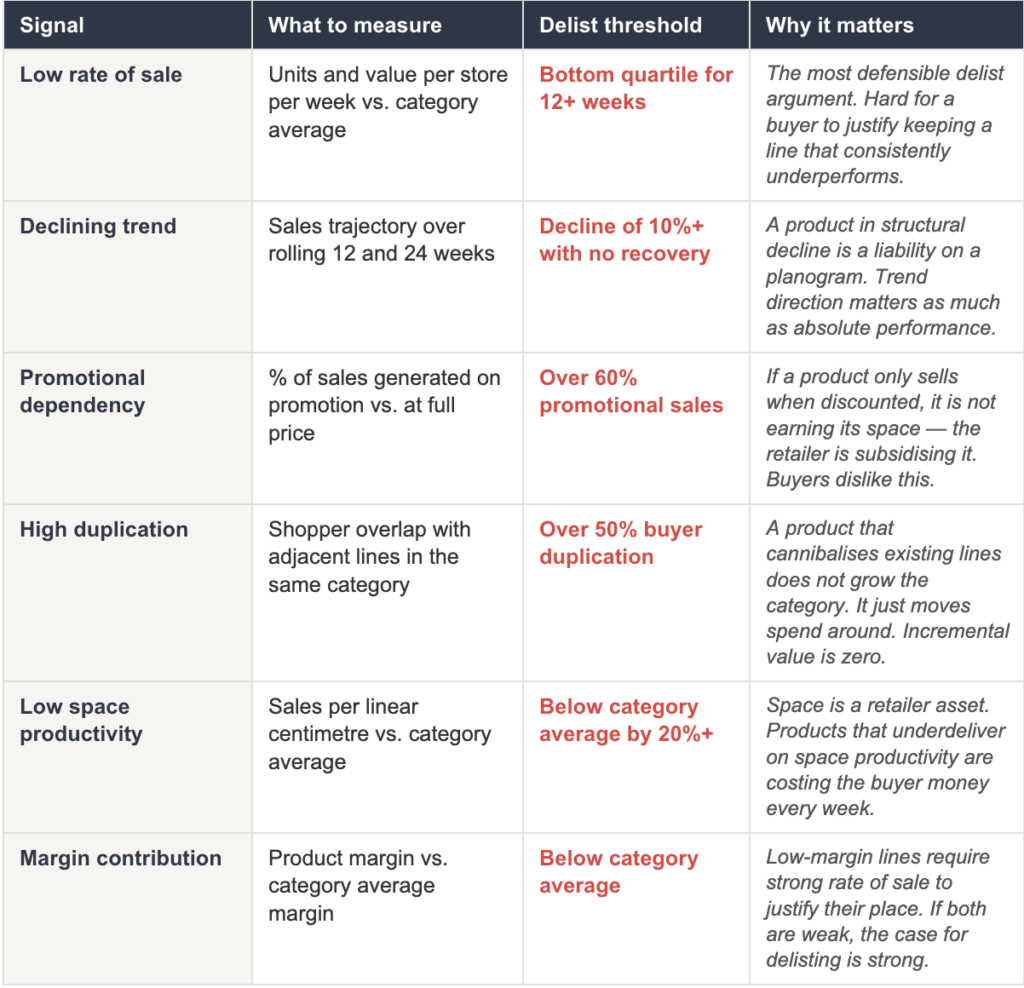
The smartest pitches answer a question most brands never ask: which product should we be replacing, and why?
Identifying the right delisting candidate and bringing that analysis to the meeting shows a buyer that the brand understands the category, has done the work, and is making their decision easier rather than harder. It is a bold move. It is also one of the most effective things a pitch can do.
Here is the data-based framework for recommending which product should come out:
Having seen this from both sides, the gaps are consistent. These are the mistakes that cost listings:
Whether the target is a national retailer, a regional distributor, or a significant B2B buyer, this is the process that gives a pitch the best chance of converting.
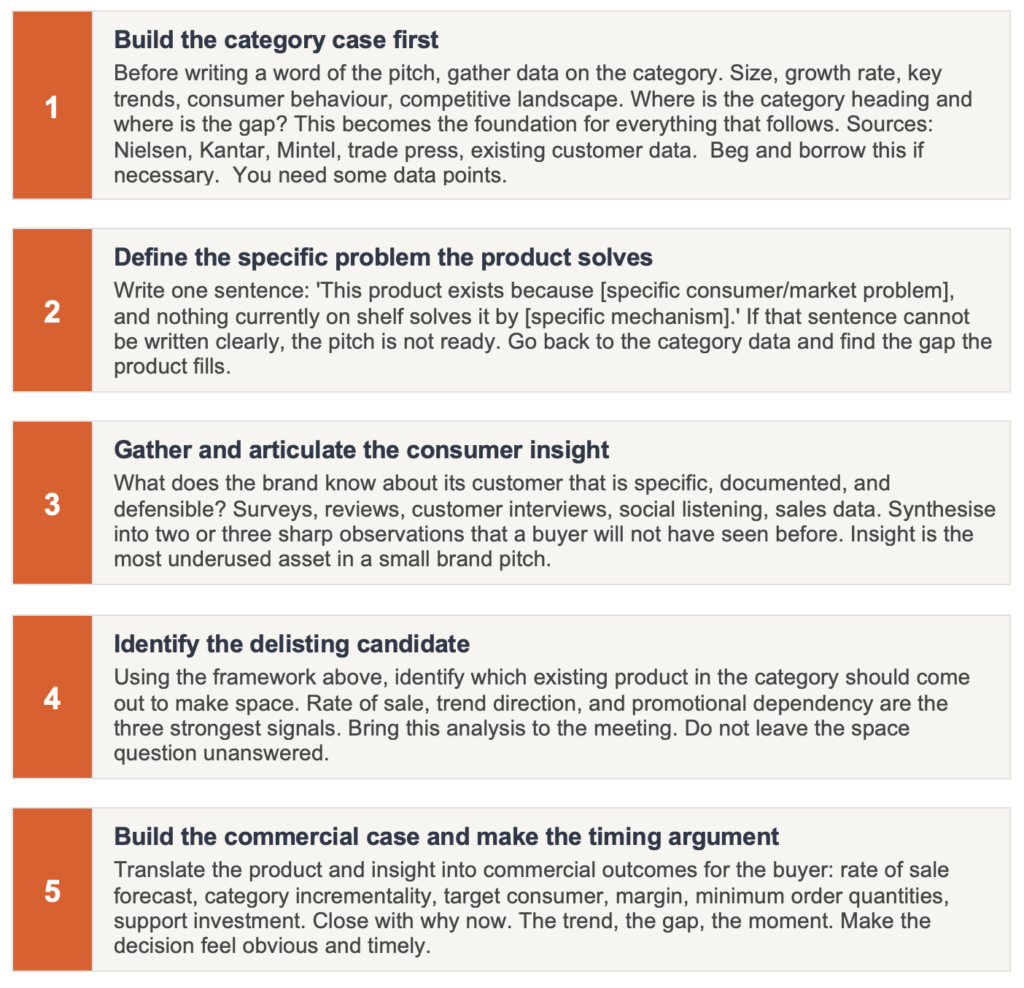
None of this replaces a good product. A strong pitch will get a brand into the room. It will not keep a product on shelf if it does not sell. Your marketing needs to go hard once it’s in to make sure consumers actually buy it.
But a great product with a weak pitch rarely gets the chance to prove itself. The brands that build commercially confident pitches, the ones that understand the buyer’s problem, answer the space question, and make the category decision easy, get listed, get into more stores, and get the second conversation that turns a trial into a partnership.
The buyer sitting across the table is not a customer. They are a commercial gatekeeper with their own targets and their own manager to answer to. Speak their language, answer their hardest question before they have to ask it, and a brand will go further than most of the pitches in the room.
“A brilliant product deserves a commercially intelligent pitch. The two together are what get listings.”

If it all feels a bit much, we’re here to help. Since starting out we’ve come to realise that many businesses need help to build realistic plans and achieve growth.
Little Spark Strategy works with a small number of manufacturer and founder-led product businesses on their commercial marketing strategy. If you are preparing for a major listing or buyer pitch and want a senior perspective from someone who has sat on the other side of that table, get in touch.