
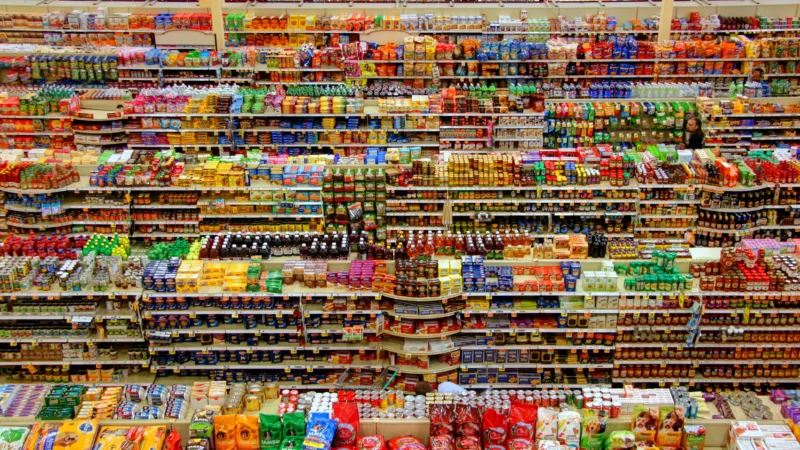
Most product ranges are a result of accumulated ideas built over a period of time. They are made with good intention but don’t always work the way you think they should.
Most makers know how many products are in their range, but if you ask why, the answer often isn’t clear. More often than not, a range grows organically because people ask for another size or a colour takes off, then there are the slow sellers that are hard to optimise.
The results are a product range that that is built on momentum and capacity, not on strategy. Not necessarily fatal in itself, but it can be expensive.
What it costs:
A strong product range is a system and every product in it should have a clear role.
Before we get into structure, here’s a test: for every product in your current range, can you finish this sentence in one line?
“This product exists in the range because…”
If there are any you hesitate over, that product might be costing you more than it’s earning you. Read on!
In a healthy range, products tend to fall into a few distinct roles:
The entry product. This can often be the hook (but not always!). If your customers are price motivated or unsure of the brand, an accessible price-point is easier to say yes to. Its role in range isn’t to make the most money, it’s to get a customer in. Once they are through the door, it’s easier to trade them up (see our pricing issue on value stacking!) or encourage return purchases.
The cash cow. The product that keeps the lights on. It sells reliably, is well-understood by customers and margins on it are strong. This is the nucleus of the range and all other products should have an associated role to it.
The premium. Your most capable, most margin-rich product. It should be something that is differentiated, stands out from the crowd and showcases what is possible from your brand, because of this, everyone should knows it exists.
The sacrificial product. This one is probably the most surprising. A sacrificial product is deliberately positioned to make something else look better value. It can be extremely basic (making the step-up feel like a bargain) or extremely premium (diverting attention from competitors and making the cash cow feel like the sensible choice). Its role is as a comparison to make other products around it more appealing.
Every product should map to one of these roles. If it doesn’t — if you genuinely can’t work out what job it’s doing — that’s worth sitting with.
There’s a simple study that gets cited a lot in marketing circles and we think it’s gold-dust for product makers.
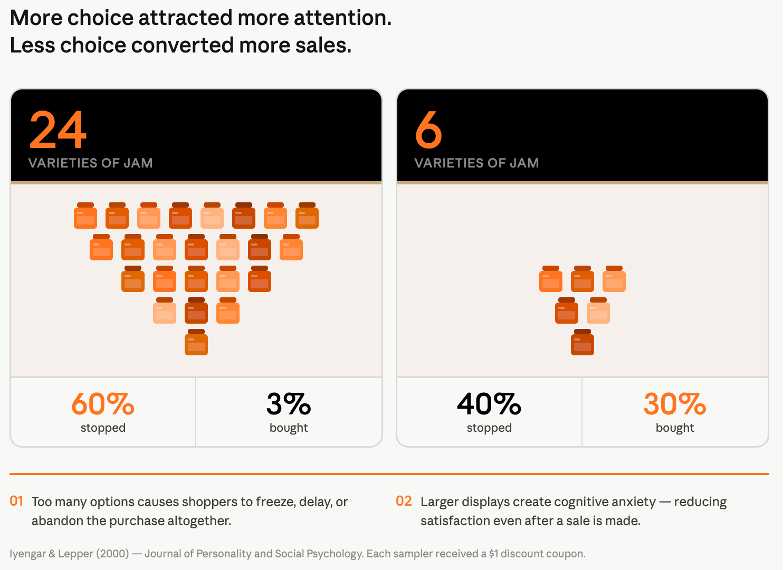
A researcher set up two jam-tasting stalls, both offering a $1 coupon for anyone who sampled the jam. One stall offered 24 varieties and the other offered 6 varieties.
More people stopped at the 24-jar stall however fewer people bought from it, what this shows is that too many options cause shoppers to freeze and abandon purchasing all together.
In 2004, psychologist Barry Schwartz published The Paradox of Choice: Why More Is Less. It’s become one of the most referenced books in consumer behaviour and if you sell physical products, it’s essential reading. There’s also a Ted Talk if you’re short on time – https://www.ted.com/talks/barry_schwartz_the_paradox_of_choice
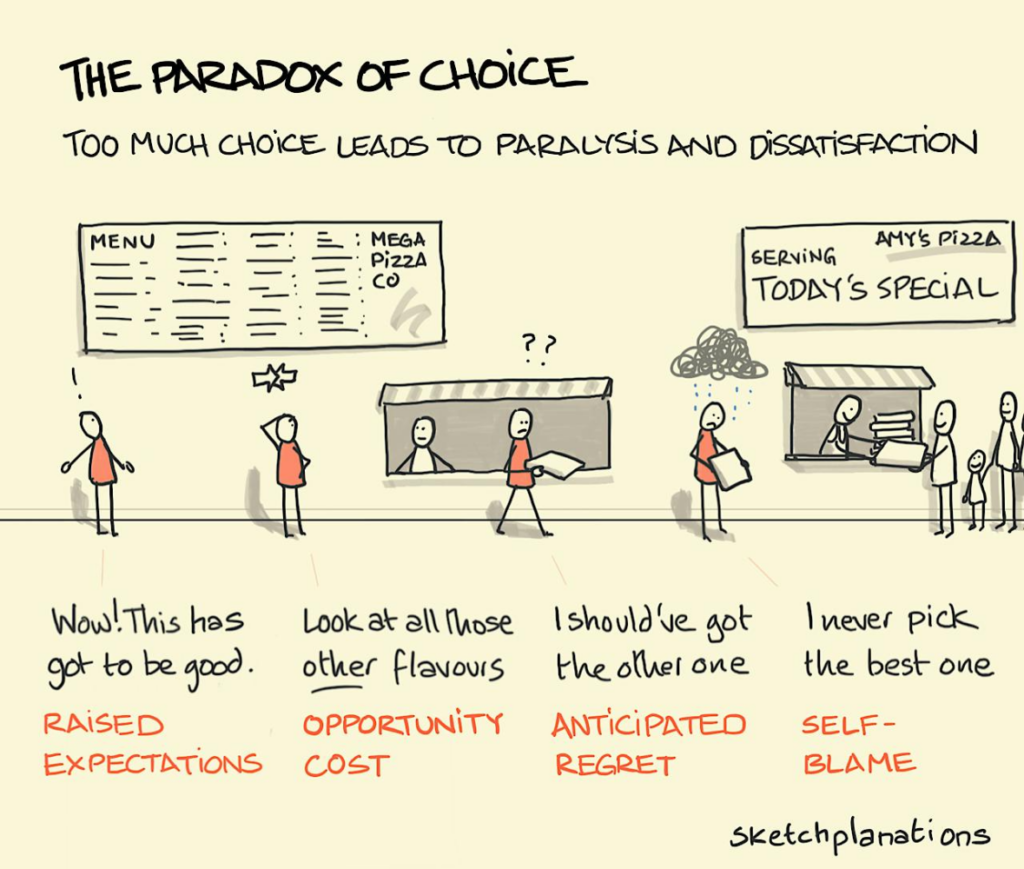
The argument, backed by extensive research, is that past a certain point, more choice burdens people rather than liberating them. Burden shows up in three specific ways that are directly relevant to how you build a range:
1. Decision paralysis. When people face too many options, the mental effort of comparing them becomes costly. Rather than making a choice, a significant number of people make no choice at all and leave. If you’ve ever wondered why a customer browsed your full catalogue and didn’t buy anything, this may be part of the answer.
2. The paradox itself: more choice = less satisfaction. Here’s the counterintuitive part. Even when people do choose from a large range, they tend to feel less satisfied with what they picked than people who chose from a smaller one. Why? Because a wider range raises the implied standard. With 20 options available, the customer believes the perfect choice must exist somewhere in there, and if they didn’t find it, they failed. With 4 options, they made the best call they could.
3. Regret and second-guessing. Schwartz identified two types of decision-makers: maximisers, who feel compelled to find the absolute best option, and satisficers, who stop when they find something good enough. Maximisers are particularly susceptible to post-purchase regret. The more options that existed, the more likely they are to wonder if they chose correctly. That regret erodes satisfaction, reduces the chance of a repeat purchase and makes a recommendation to someone else less likely.
The takeaway for product makers is not to sell fewer things by default but to make choice feel easier.
If your range does not do that work for the customer, you risk losing them to paralysis or keeping the sale but losing their satisfaction.
The rule of thumb worth knowing:
For most independent product makers and mid-sized manufacturers, a core range of 3–5 products with a clear entry, mid and premium tier, outperforms ranges of 10–20 in both conversion and margin. Beyond that, you need exceptional merchandising and a clear reason to exist for every SKU.
What separates a list of products from an actual range? A range should make it easy for your customer to spend more than they planned to. Compelling logic rather than sales pressure is the key to achieving trade-up.
For a trade-up to work, every step up your range needs to answer three questions clearly:
If your customer has to think hard to answer any of those questions, the step up will probably fail. They might buy the cheaper option, or they’ll leave.
The most common mistake makers make is building trade-up ladders based on features the maker cares about, rather than benefits the customer wants. A better material, a higher spec, more components are interesting to you but do they appeal to your customer? They want to know what it means for them.
Frame every step up in your range from the customer’s perspective. Not ‘this has a reinforced base’ but ‘this is the one that lasts twice as long so you’ll only buy it once.’
Begin to sense-check your range by answering these questions:
We’d love to hear back how you found this exercise and what you’re planning to adjust.

If it all feels a bit much, we’re here to help. Since starting out we’ve come to realise that many businesses need help to build realistic plans and achieve growth.
As two ex-corporate professionals with the experience of building both local and global plans, often with limited resources, we have the knowledge to share.